University of California has one of the largest public academic health systems in the nation, comprising six academic health centers and 21 health professional schools.
10.1.1 Academic health centers and health professional schools

source: University of California Health
University of California operates 21 health professional schools, a global health institute, and systemwide health care services for UC employees and students. UC has six academic health centers: UC Davis Health, UCI Health, UCLA Health, UCR Health, UC San Diego Health, and UCSF Health.
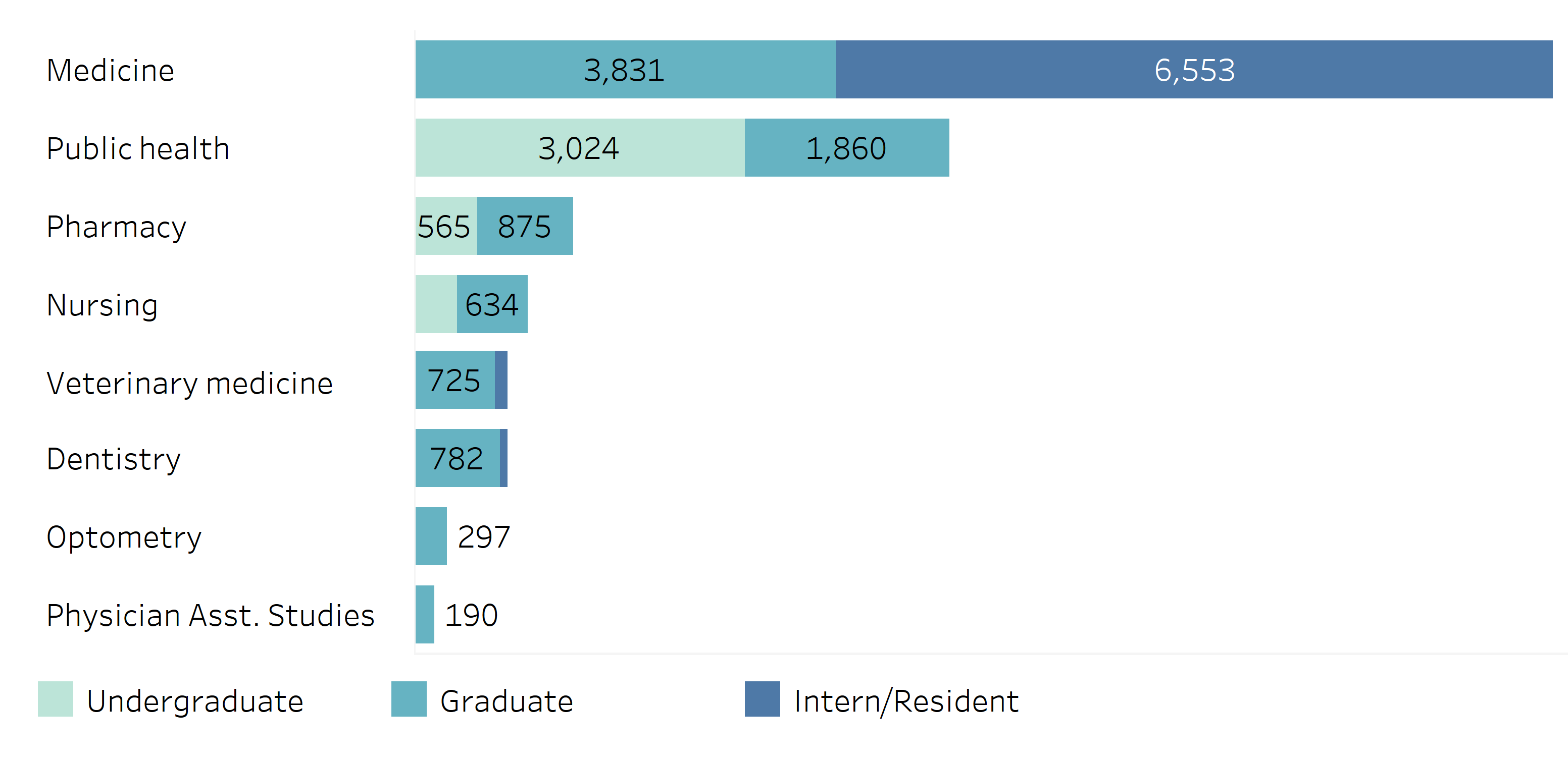
UC is home to one of the largest health professional instructional programs in the nation with schools spanning seven health professions and including 13,200 health professional graduate and undergraduate students.
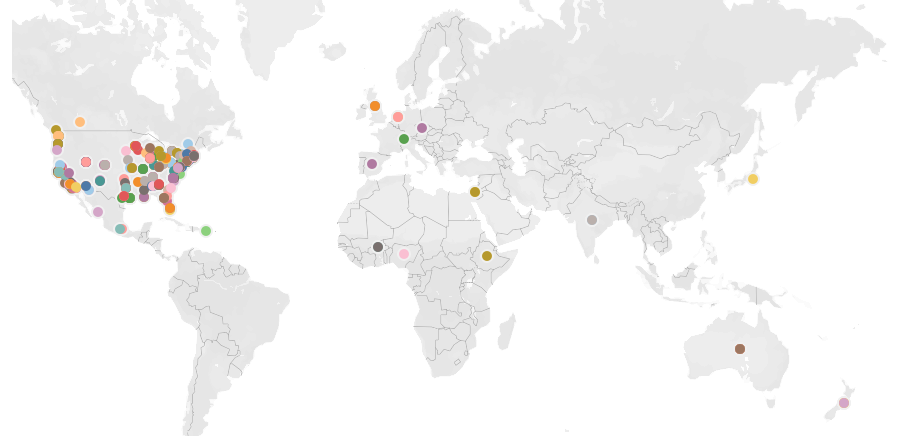
University of California participates in almost 5,000 active clinical trials across the globe as either a sponsor or a trial site.
10.1.2 University of California-affiliated clinical trials

UC clinical trials dashboard | Map
source: UC BRAID’s UC Health Clinical Trials dataset
University of California sponsors 1,296 clinical trials at UC and other facilities across the globe, plus UC locations are participating sites in 3,636 trials conducted by other organizations including biotechnology companies, nonprofits, other colleges and universities, and government agencies.
The nearly 5,000 clinical trials span 2,500 specific conditions, ranging from cancers and chronic illnesses to neurological and behavioral disorders.
The UC Information Center dashboard linked above provides details on the status and phase of clinical trials, study types, and conditions involved, as well as the sponsors of the clinical trials.
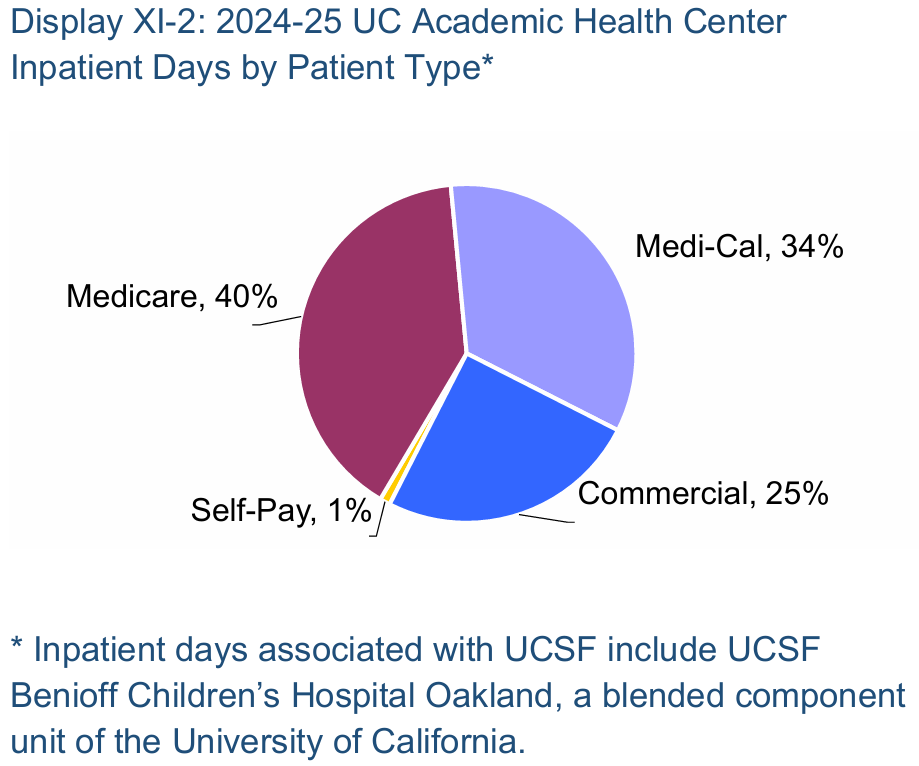
Approximately one-third of UC’s hospital beds are in service to Medi-Cal members every day.
10.2.1 Inpatient days by patient type, 2024–25

Budget for Current Operations report | page 108
source: UC Budget for Current Operations report
UC’s health care professionals also deliver primary and specialty care to lower-income Californians beyond the University’s medical centers and clinics. UC’s health locations have established partnerships to expand patient care services into local communities and make UC’s world-class health professionals more accessible for Medi-Cal members. In addition to providing care at UC-owned locations, UC health professionals deliver services to Medi-Cal members at partner county hospitals, community hospitals, and Federally Qualified Health Centers (FQHCs).
At least 1,000 OB-GYN, pediatrics, family medicine, and psychiatric residents and fellows deliver care at UC partner facilities that serve very high percentages of Medi-Cal members.
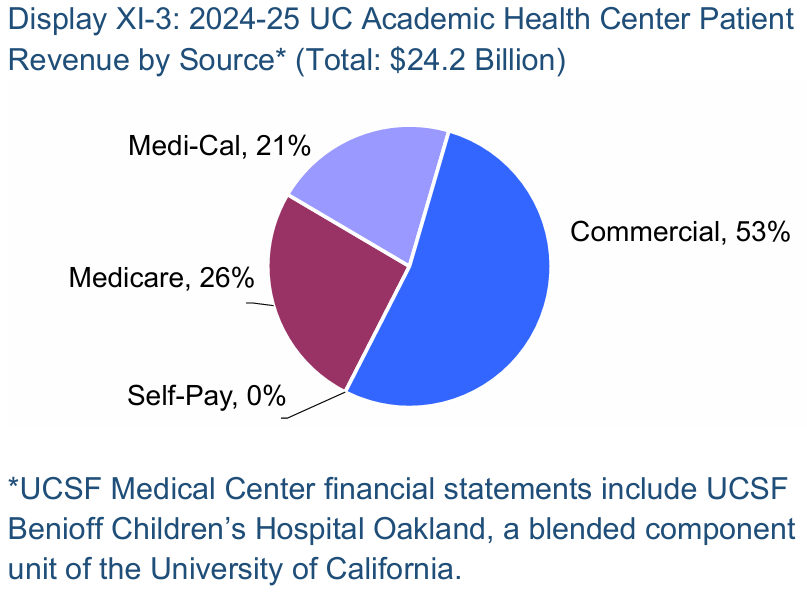
UC’s health locations do not receive State General Fund support and have to be financially self-supporting through reimbursements received from a mix of payors for care provided to patients.
10.2.2 Sources of reimbursements for care delivered by payor type
Budget for Current Operations report | page 109
source: Budget for Current Operations report
UC’s not-for-profit academic health centers must generate their revenues through reimbursement for care delivered. These funds cover the costs of clinical operations, provide financial support to UC academic programs and subsidize uncompensated care for Medi-Cal and Medicare members and Californians who are in need and underinsured. The academic health centers do not receive financial support from the State’s General Fund.
As academic health centers and safety net hospitals, UC locations are a critical part of the state’s health care ecosystem.
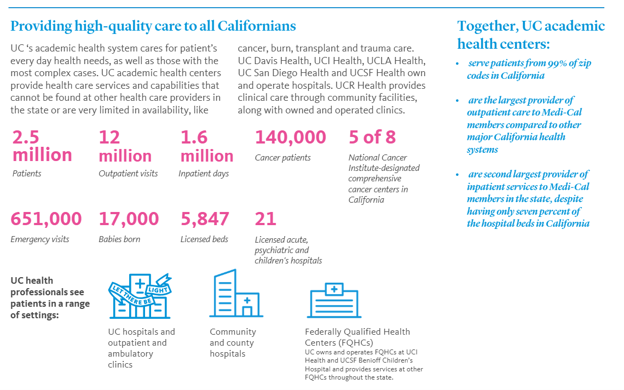
10.2.3 Patient complexity (Case Mix Index), patient days, outpatient visits, and hospital admissions, UC medical centers

University of California Medical Centers 2024–25 Annual financial report | page 25
source: University of California Medical Centers 2024–25 Annual financial repor
 |
|
UC academic health centers care for patients’ everyday health needs, as well as those with the most complex cases. UC’s health locations provide health care services and capabilities that cannot be found at other health care providers in the state or are very limited in availability, like cancer, burn, transplant, and trauma care. UC Davis Health, UCI Health, UCLA Health, UC San Diego Health, and UCSF Health own and operate hospitals. UCR Health provides clinical care through community facilities, along with owned and operated clinics. |
The University of California educates and trains nearly 17,000 health professional graduate and undergraduate students and residents annually.
10.3.1 Health professional students by discipline, fall 2025
source: UC Information Center data warehouse
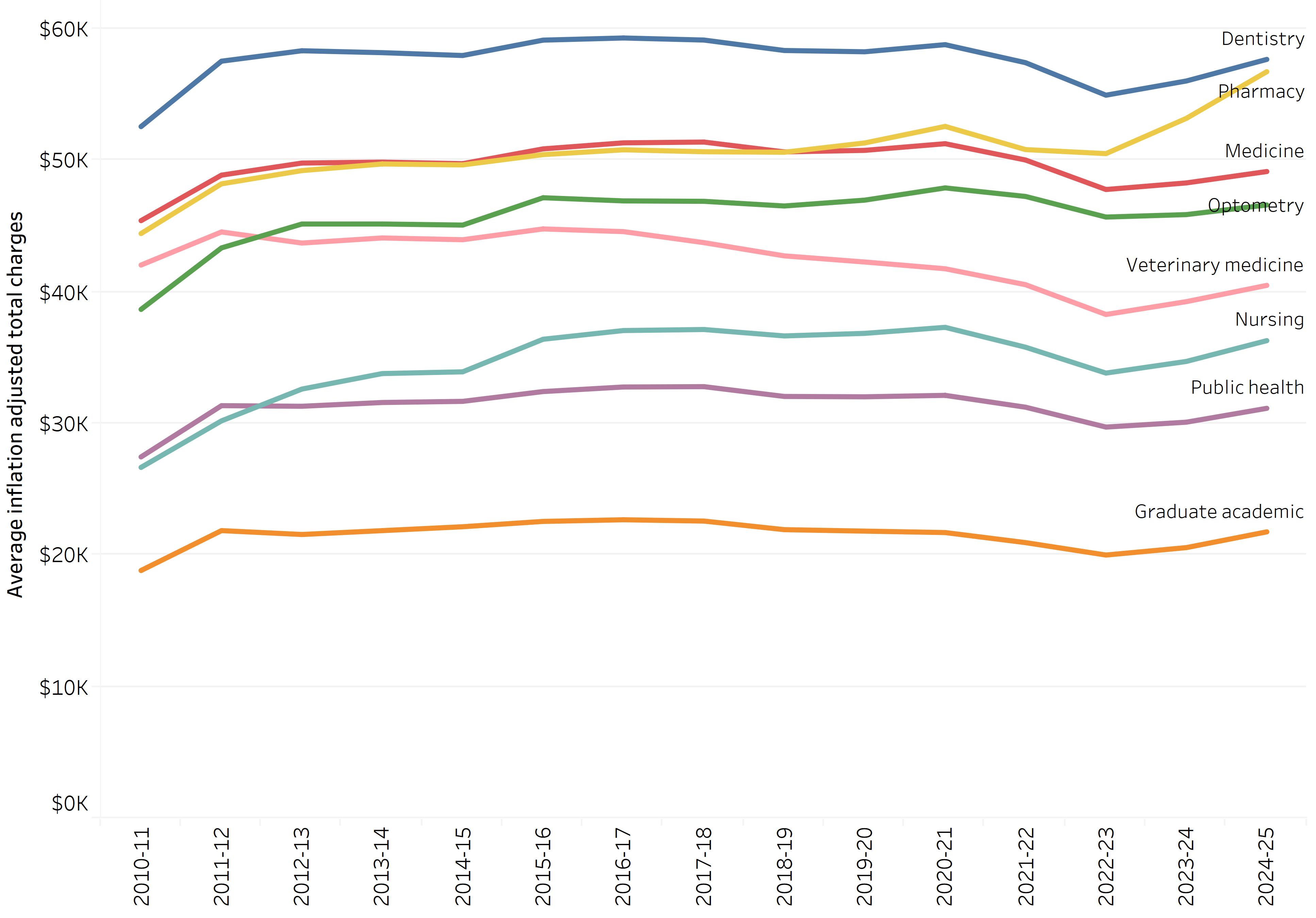
Inflation-adjusted health professional degree fees have remained steady or declined for most programs.
10.3.2 Average total charges for health professional degree students, Universitywide, 2010–11 to 2024–25
source: UC Budget Analysis and Planning
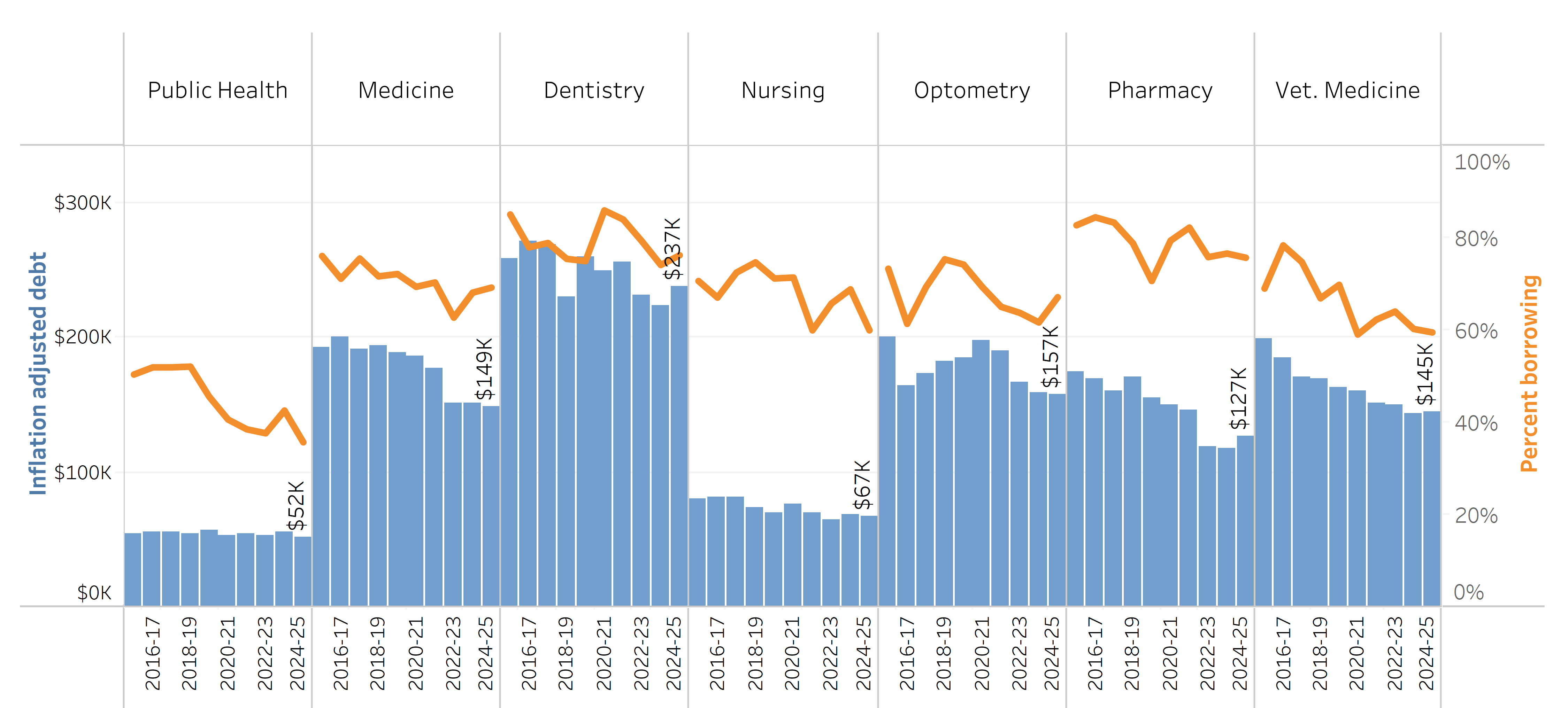
Average health professional degree student debt levels are relatively flat or decreasing over the last ten years.
10.3.3 Health professional degree student debt at graduation, Universitywide, 2015–16 to 2024–25, selected years labeled
Graduate student financial support and debt at graduation dashboard
source: UC Information Center
For more information
Explore the UC Information Center dashboards that provide downloadable data and context about the University of California
universityofcalifornia.edu/about-us/information-center
In addition to those dashboards supporting indicators in this chapter, other examples include:
Other resources
Download data tables for chapter 10 indicators (Excel format)
Chapter Ten: University of California Health
Key takeaways:
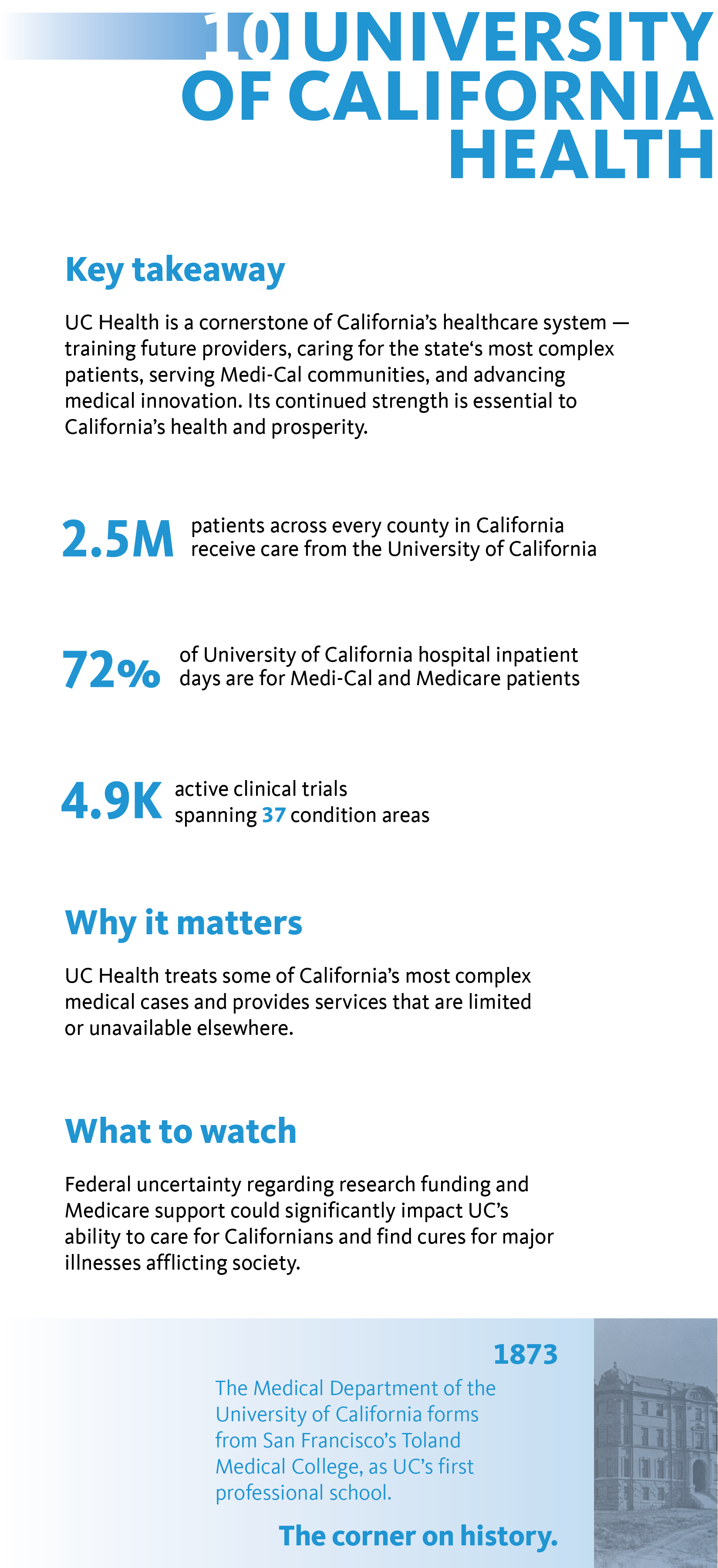
- University of California Health is a cornerstone of California’s healthcare system — training future providers, caring for the state‘s most complex patients, serving Medi-Cal communities, and advancing medical innovation. Its continued strength is essential to California’s health and prosperity.
- Two and a half million patients across every county in California receive care from the University of California.
- Seventy-two percent of University of California hospital inpatient days are for Medi-Cal and Medicare patients.
- UC is involved in more than 4,900 active clinical trials spanning thirty-seven condition areas.
Why it matters:
UC Health treats some of California’s most complex medical cases and provides services that are limited or unavailable elsewhere.
What to watch:
Federal uncertainty regarding research funding and Medicare support could significantly impact UC’s ability to care for Californians and find cures for major illnesses afflicting society.
UC’s corner on history:
In 1873, The Medical Department of the University of California forms from San Francisco’s Toland Medical College, as UC’s first professional school.