UC Agriculture and Natural Resources brings the power of UC research and education beyond campus borders to local communities in every county in California.
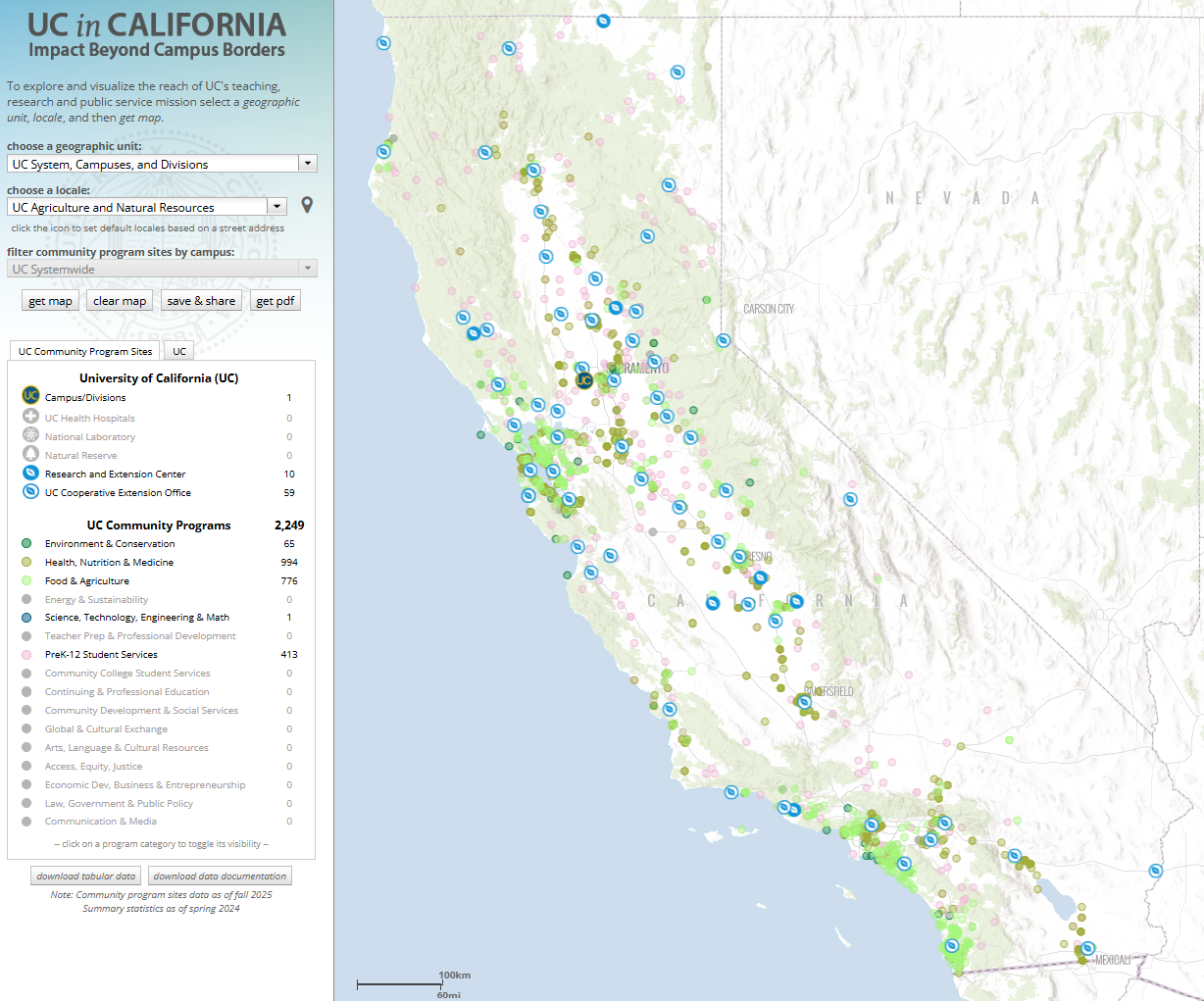
11.1.1 UC Agriculture and Natural Resources program locations in 2026

UC in California: Impact beyond campus borders | UC ANR community-based programs
source: UC ANR
UC Agriculture and Natural Resources (UC ANR) operates the statewide UC Cooperative Extension (UCCE) in 59 offices with a network of 375 UCCE academics and 350 community educators, who serve as the University of California’s “community ambassadors” delivering educational programs in every California county. In 2025, UC ANR had 2,249 community-based program sites and made 639,437 significant educational exchanges with adults and youth statewide.
UC ANR administers 17 statewide programs/institutes and ten Research and Extension Centers (RECs). The RECs are strategically located from the Oregon border to Mexico and from the Sierra Nevada to the Pacific, and provide land, expertise, and facilities for research, education, and community engagement. For example, one statewide program — CalFresh Healthy Living, UCCE — reported making policy, system, and environmental changes, that improve rules, programs, and physical spaces to support healthier choices. The program operated at 478 SNAP Ed sites, which are community places that offer nutrition education for people with limited incomes. These changes helped improve the health and well-being of more than 167,100 people.
UC Agriculture and Natural Resources operates California’s 4-H Youth Development Program.
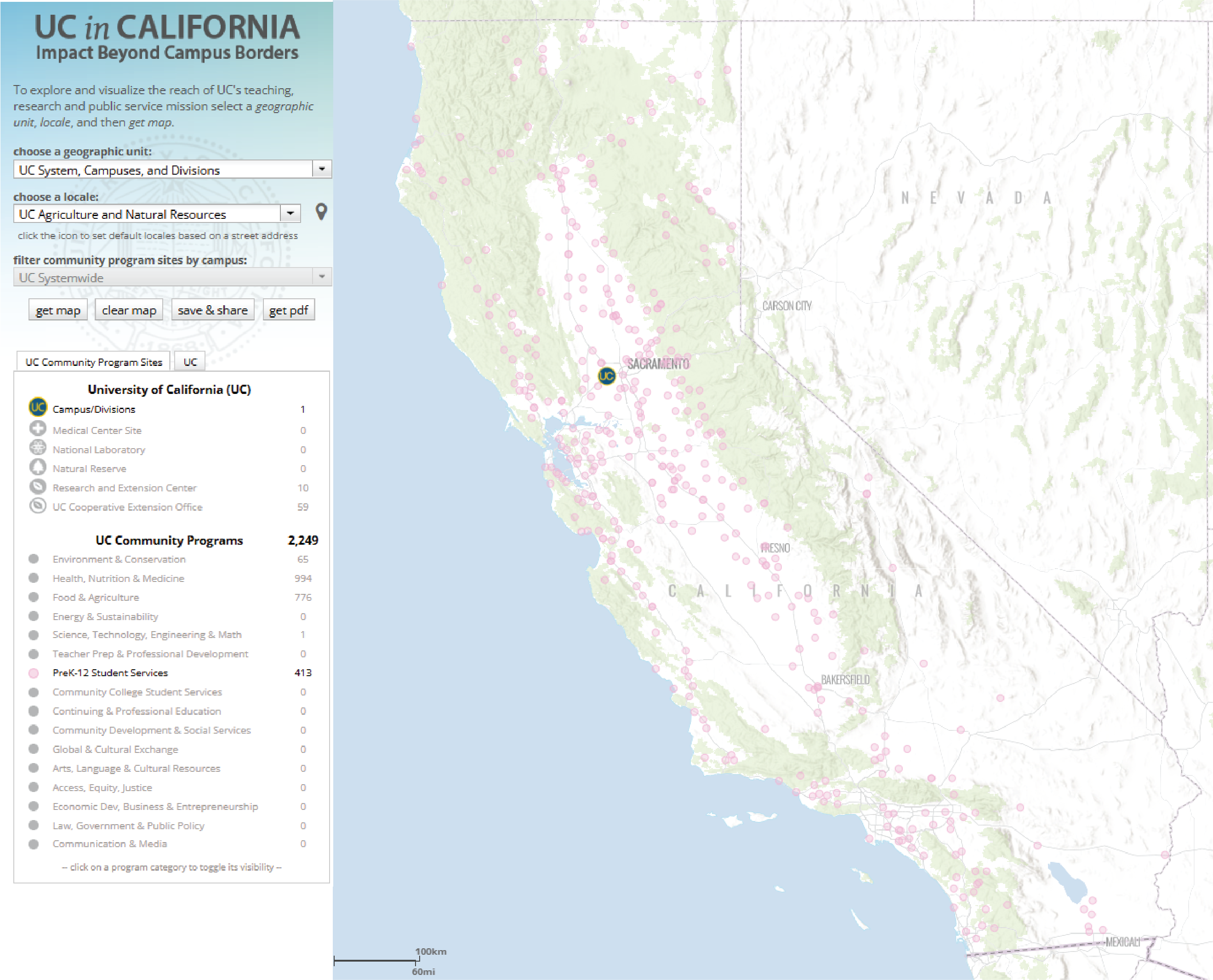
11.1.2 UC Agriculture and Natural Resources: 4-H Youth Development program sites in 2026
UC in California: Impact beyond campus borders | 4-H programs
source: UC ANR
UC ANR manages and delivers the California 4-H Youth Development Program, which is open to all youth ages five to eighteen in every county in California. 4-H operated at 413 sites with participation of 75,467 youth in three primary content areas: civic engagement and leadership, healthy living, and Science, Technology, Engineering, and Mathematics (STEM). The program had 7,803 volunteers, who contributed 62 percent of the total UC ANR volunteer hours, serving as mentors, educators, and chaperones to guide the youth in building leadership, civic, and life skills.
For example, a UCCE 4-H Youth Development community-based academic led the planning of the 2025 North Bay Science Discovery Day for the public to engage with 150 hands-on activities hosted by 107 exhibitors and supported by 72 sponsors and 150 volunteers. The event was attended by almost 12,000 people. Exit survey respondents reported the event sparked wonder and curiosity about STEM (89 percent) and an increase in their interest in STEM (91 percent). Additionally, 96 percent of attendees were able to speak to a scientist or engineer, increasing access to STEM role models.
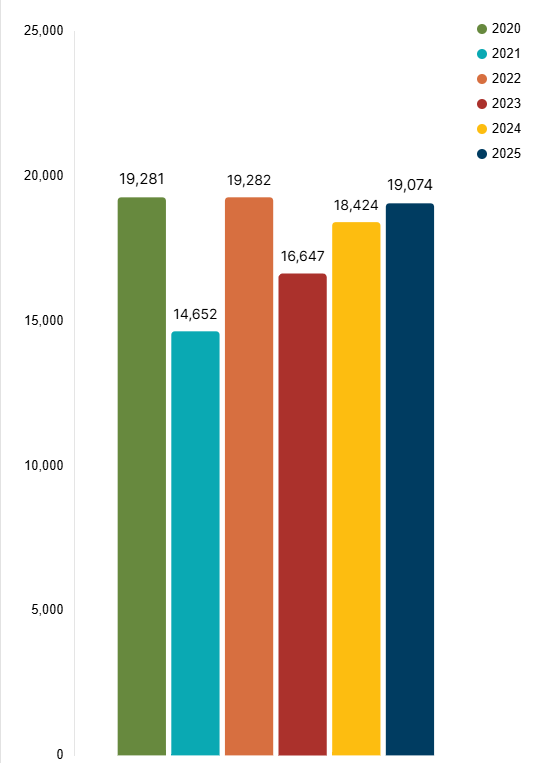
UC Agriculture and Natural Resources had 19,074 volunteers statewide who contributed 1.5 million hours of public service across California, valued at $60,620,592.
11.1.3 UC Agriculture and Natural Resources public volunteer total headcount, 2020–2025
source: UC ANR
Six of UC ANR’s seventeen statewide programs train community members in science-based curricula on nutrition, food safety, environmental stewardship, and sustainable gardening; these community members then volunteer to engage the broader public in educational activities across the state. The UC ANR volunteers make millions of face-to-face contacts with Californians each year, strengthening community-University relationships and improving the visibility and reach of UC well beyond the campuses. A volunteer satisfaction survey indicates a high degree of community members’ satisfaction with their role, with an increase from 5.50 to 5.74 on a seven-point scale between 2018 and 2023.
The volunteers contribute significant public benefit. For example, the UC Master Gardener Program volunteer-led education resulted in over 1,748 Californians reporting in 2025 that they started or improved gardening practices on nearly 8.2 million square feet of home landscapes statewide, and 135 participants reported that they applied practices to over one million square feet of school and community gardens. The UC Environmental Stewards Program certifies California Naturalist volunteers, and as a result of their stewardship projects, it is estimated that over 37,000 hours of service improved land stewardship across the state, given that roughly 19 percent of all their volunteer service is direct conservation and restoration.
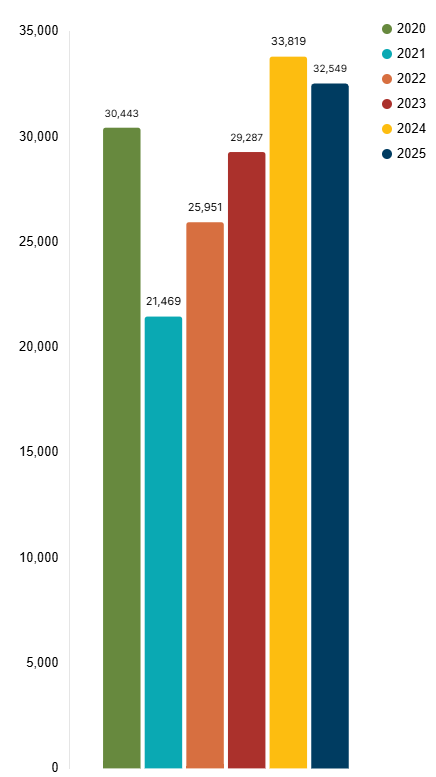
UC Agriculture and Natural Resources academics organized 32,549 research-based educational classes and workshops for Californians.
11.1.4 UC Agriculture and Natural Resources-organized educational total activities: meetings, train-the-trainer, workshops, field days, and courses, 2020–2025
source: UC ANR
UC ANR listens to communities on how they want to receive science-based information, and then delivers a variety of UC Cooperative Extension educational activities to meet those needs, including organizing meetings, workshops, courses, and field days. To extend its reach and empower communities, UCCE also leads train-the-trainer activities. These efforts serve California’s public, including farmers, ranchers, land managers, families, community organizations, government, schools, and California Tribes.
For example, UCCE is expanding the career pipeline in forestry and fire management through training. Loss of technical expertise and skilled labor in forestry and fire management is one of the greatest threats to maintaining healthy forest ecosystems: 40 percent of natural resource industries experience labor shortages, with employers indicating 30 percent of positions being unfilled. The UC ANR Fire Network leads transformative training for fire practitioners (including men) through the Women-in-Fire Training Exchange (WTREX) Program. Since 2016, 750 people have participated in WTREX, and events have been hosted in five US states and seven countries across five continents. One participant shared: “I am not the same firefighter, nor the same woman, as day one of WTREX. I am a firefighter with new knowledge and an empowered woman, confident in my abilities.”
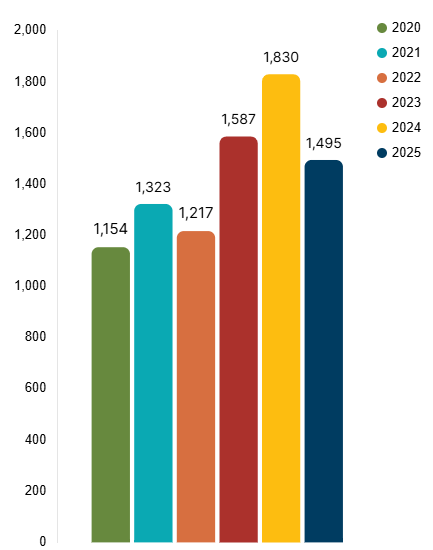
UC Agriculture and Natural Resources extended 1,495 science-to-policy activities to help inform policies at schools, community organizations, and all levels of government.
11.1.5 UC Agriculture and Natural Resources total science-to-policy activities, 2020–2025
source: UC ANR
UC ANR has a long history of providing research that informs, builds, and strengthens policy related to agriculture, natural resources, nutrition, and youth and community development in California and the nation. UC ANR academics and staff conduct science-to-policy activities, which include extending knowledge and research-based information with clientele during any stage of policy development or implementation process (i.e., agenda setting, formulation, legitimation, implementation, evaluation).
For example, over the last decade, UC ANR has increasingly focused on informing fire-related policies and facilitating a more science-based public understanding of how to sustainably live on fire-prone landscapes. UCCE’s fire research informed California’s Zone Zero regulations, which aim to establish a mandatory five-foot ember-resistant buffer around homes in high-fire areas. New insights and information about parcel- and community-scale risk and plant flammability have helped expand the vegetation options being considered in the development of these fire-related land use planning regulations. These changes have informed efforts to rebuild more sustainably after the January 2025 urban conflagrations.
11.1 EDUCATIONAL PARTNERSHIPS
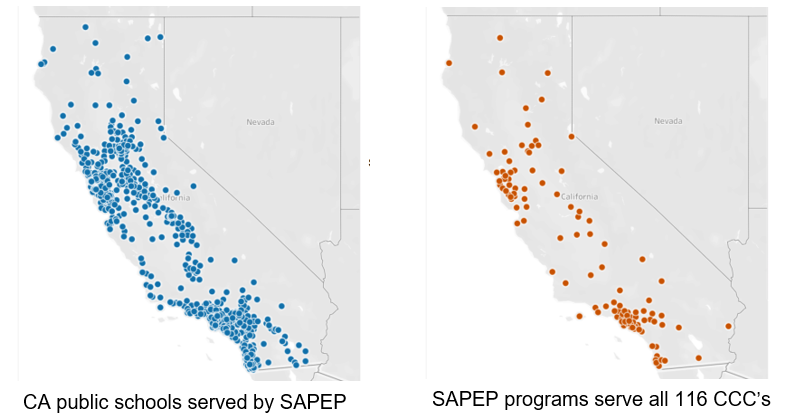
UC’s Student Academic Preparation and Educational Partnerships (SAPEP) helped prepare 293,539 California students for college and university in 2023.
11.2.1 Graduate, Undergraduate and Equity Affairs programs: Student Academic Preparation and Educational Partnerships (SAPEP)

Student Academic Preparation and Educational Partnerships (SAPEP) outcomes dashboard | Schools served
source: UC Information Center
Student Academic Preparation and Educational Partnership (SAPEP) programs were created to reduce disparities in college access and preparation levels among public school students, thereby expanding the following groups: California high school students who matriculate to two- and four-year postsecondary institutions; California community college students who transfer to four-year postsecondary institutions; and undergraduate students who pursue graduate and professional degrees.
- UC’s SAPEP portfolio comprises thirteen educational programs.
- Early Academic Outreach Program (EAOP), K-20 Regional Intersegmental Alliances (P-20), Mathematics, Engineering, Science, Achievement (MESA), Puente, Student-Initiated Programs (SIPS), UC Links and UC Scout support California K-12 students with early engagement, college preparedness, and A-G course completion.
- Articulation, ASSIST, MESA, Puente, and Transfer Prep support California Community College students with transfer readiness and support.
- MESA provides services to students in all 116 of California’s community colleges.
- ArtsBridge, Graduate and Professional School Programs (GPSP), SIP support undergraduate students with intentions to continue to graduate school.
- UC serves almost 250,000 K-12 students and 30,000 community college students at more than 2,000 school sites in California through its SAPEP programs. Ninety percent (52 of 58) of California counties were served by SAPEP programs at one or more school sites.
11.1 EDUCATIONAL PARTNERSHIPS
UC’s K-12 outreach programs helped prepare more than 140,000 California students for college and university in 2024.
11.2.2 Graduate, Undergraduate and Equity Affairs programs: K-12 outreach programs
UC’s K-12 outreach programs dashboard
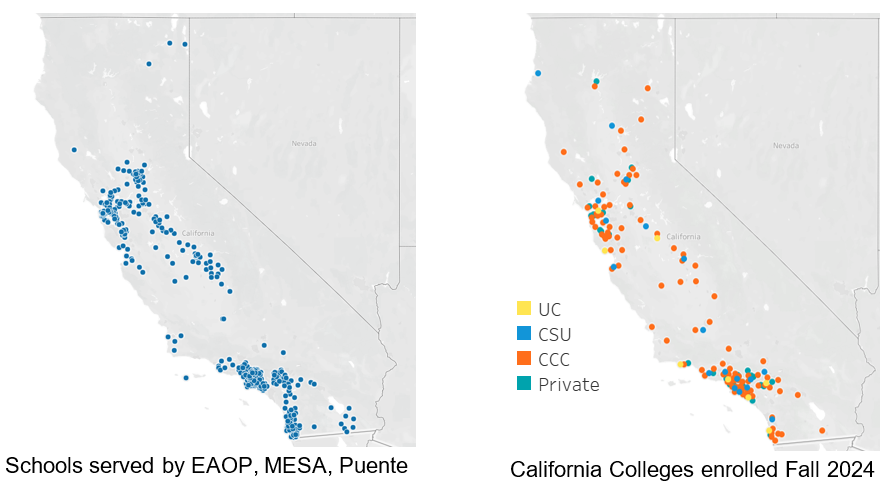
source: UC Information Center, National Student Clearinghouse (NSC)
Note: The map of California Colleges enrolled Fall 2024 does not appear in the dashboard.
- Over 140,000 students participated in EAOP, MESA, and Puente (EMP) programs in AY2023.
- Eighty-three percent of 12th grade participants in EMP completed A-G requirements. This is considerably more than the total for California public students at 45 percent, as reported by the California Department of Education (CDE).
- Seventy-two percent of 12th grade participants in EAOP, MESA, and Puente enrolled in a two- or four-year college in Fall 2024.
MESA participation by California students across the three segments increased by six percent of the program’s pre-pandemic peak and 58 percent since the pandemic low.
11.2.3 Mathematics, Engineering, Science Achievement (MESA) program participation, 2018–19 through 2023–24
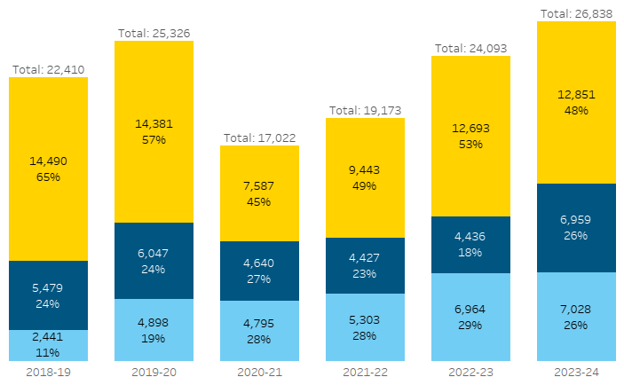
sources: MESA Statewide Salesforce, California Community Colleges Chancellor’s Office Datamart
The Mathematics, Engineering, Science Achievement (MESA) program serves students across California from middle school through undergraduate study. As an intersegmental program within the University of California, MESA partners not only with UC campuses, but also with community colleges, California State Universities, select private institutions, and K-12 schools throughout the state.
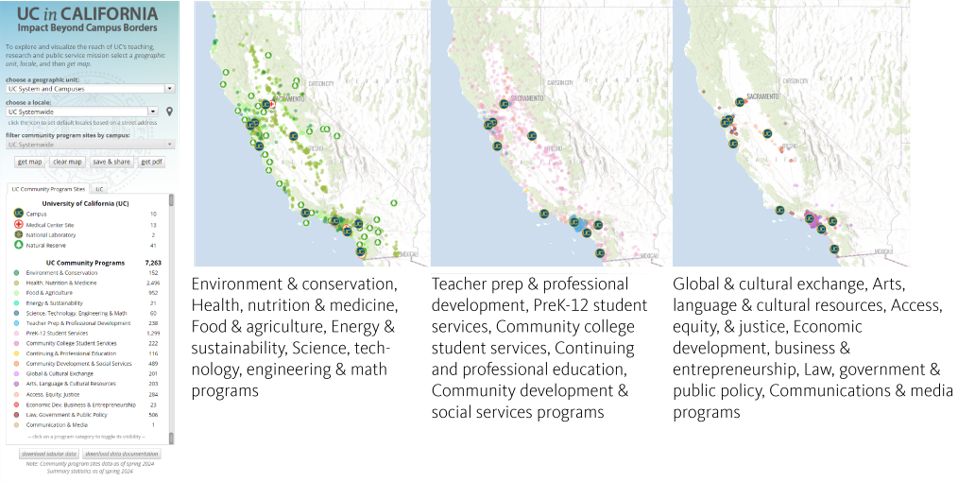
UC is involved in communities across California through a wide range of local-level service programs at more than 7,000 locations.
11.3.1 UC in California: Impact beyond campus borders, Community-based program locations, 2026
UC in California: Impact beyond campus borders | systemwide California locations
source: UC campuses
The University of California administers community-based programs at more than 7,000 sites across California, as counted in the mid-point of data collection using a new database system; many hundreds more program sites are yet to be added. All ten campuses and University of California Health, plus Agriculture and Natural Resources (ANR), UC Nature, and systemwide Graduate, Undergraduate and Equity Affairs (GUEA) contribute to the well-being of California society and California’s economic stability and growth. Explore the UC in California maps at ucinca.ucanr.edu.
For more information
Explore the UC Information Center dashboards that provide downloadable data and context on undergraduate affordability with this subject area-specific url:
universityofcalifornia.edu/about-us/information-center#public-service
In addition to those dashboards supporting indicators in this chapter, other examples include:
Other resources
Download data tables for chapter 11 indicators (Excel format)
Chapter Eleven: Public Service
Key takeaways:
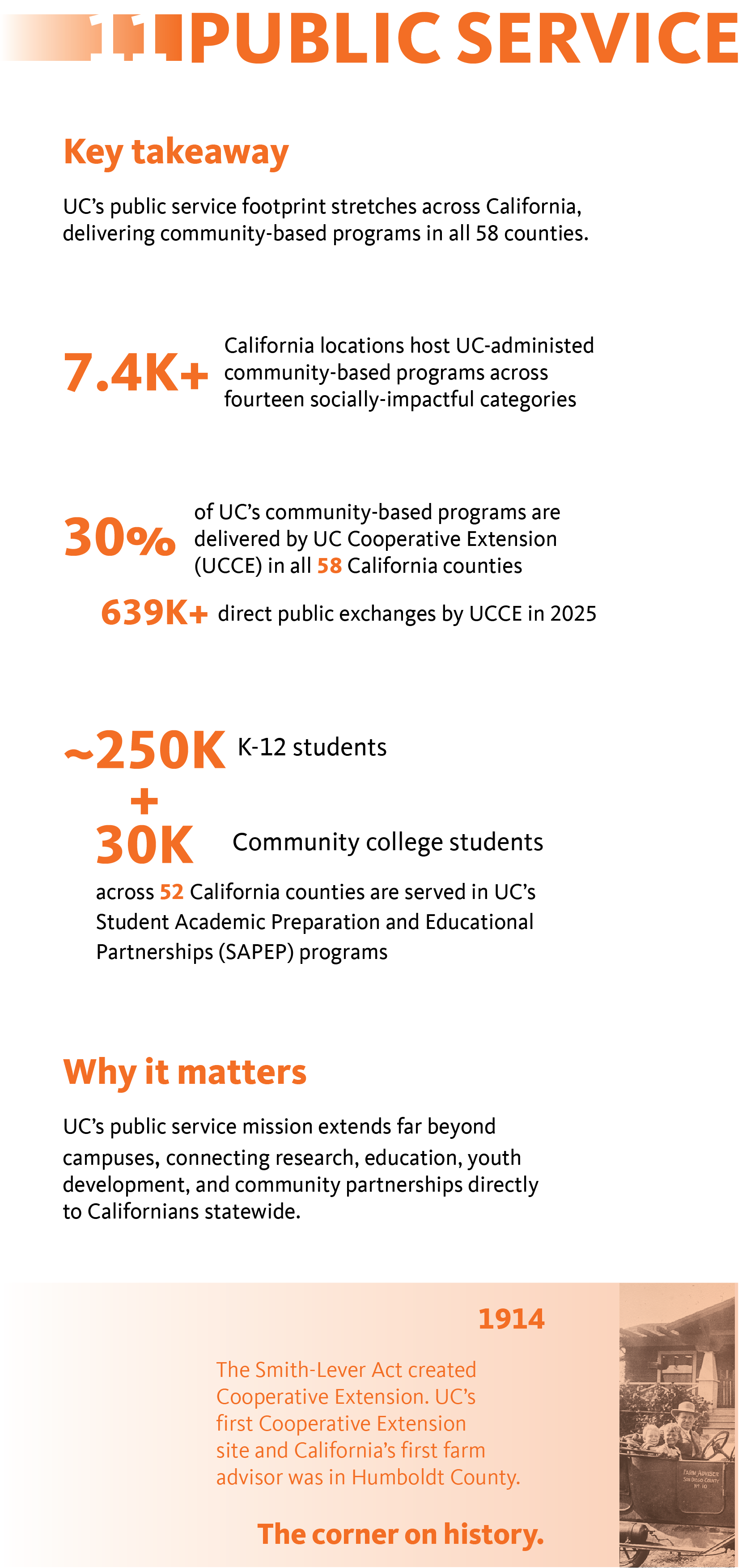
- UC’s public service footprint stretches across California, delivering community-based programs in all fifty-eight counties.
- More than 7,400 California locations host UC-administered community-based programs across fourteen socially impactful categories.
- Thirty percent of UC’s community-based programs are delivered by UC Cooperative Extension
(UCCE) in all fifty-eight California counties.
- There were more than 639,000 direct public exchanges by UC Cooperative Extension in 2025.
- About 250,000 K-12 students and 30,000 community college students across fifty-two of California’s counties are served in UC’s Student Academic Preparation and Educational Partnerships (SAPEP) programs.
Why it matters:
UC’s public service mission extends far beyond campuses, connecting research, education, youth development, and community partnerships directly to Californians statewide.
UC’s corner on history:
In 1914, The Smith-Lever Act created Cooperative Extension. UC’s first Cooperative Extension
site and California’s first farm advisor was in Humboldt County.