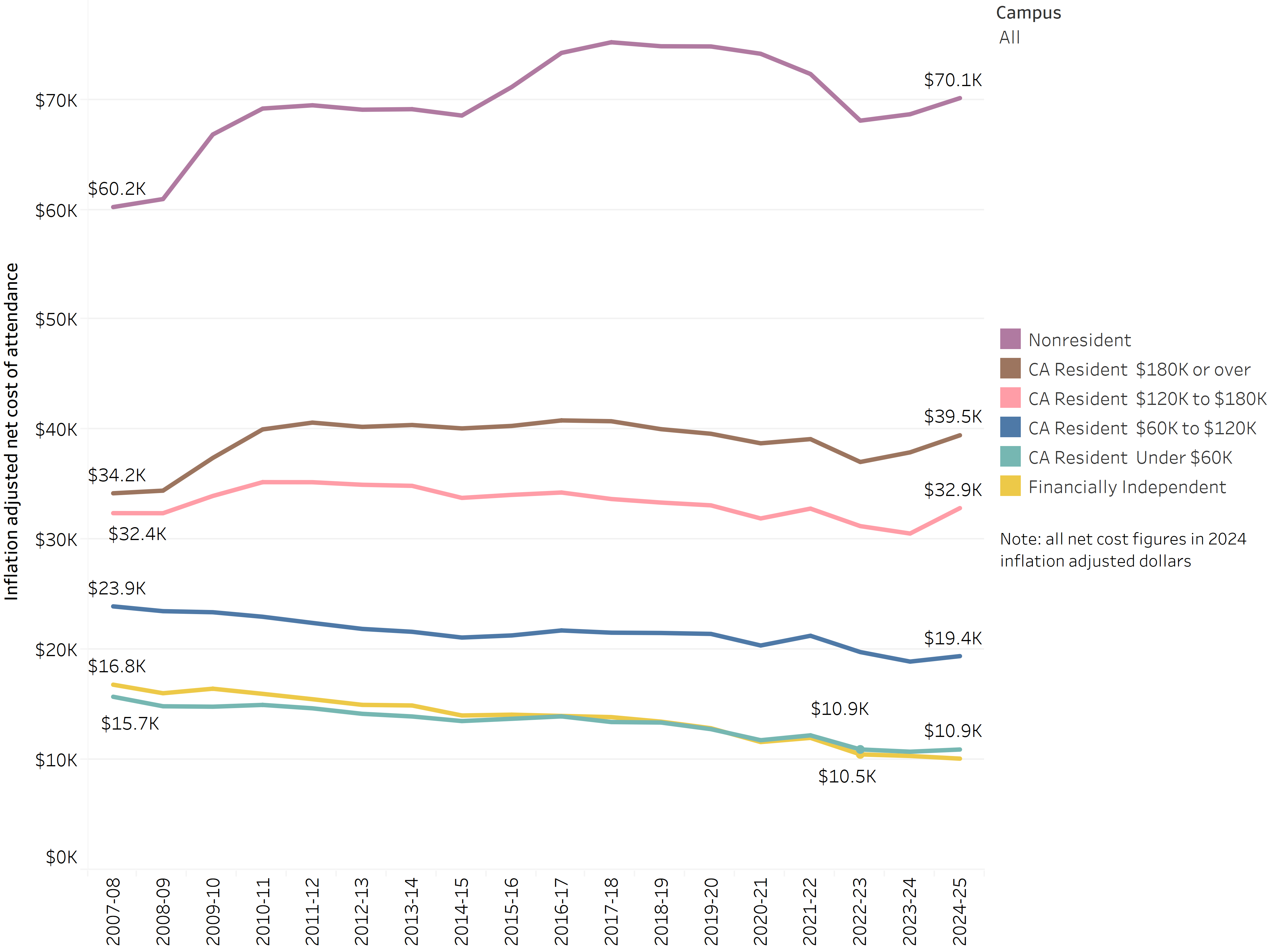
The net cost of attendance for California resident students has remained stable overall, declining for low-income students. Nonresident students face a higher net cost of attendance due to supplemental tuition charges.
3.1.1 Net cost of attendance by family income and California residency, Universitywide, 2024 inflation-adjusted dollars, 2007–08 to 2024–25

Undergraduate affordability dashboard | Net cost trend
source: UC Information Center
Net cost of attendance represents the total remaining cost of attendance for undergraduates after considering scholarships and grants. California residents, especially those from the lowest-income backgrounds, have seen their net cost of attendance remain flat or decline since 2010–11. The average net cost among low-income students has remained below systemwide sticker price since 2011 and has fallen further below it since the 2022 implementation of cohort-based tuition, which raises tuition by a prescribed and stable inflationary amount for each entering cohort. Nonresident students have also seen a stable net cost of attendance in recent years, although their net cost is much higher due to supplemental tuition charges and their ineligibility to receive institutional need-based aid. Tuition charges for out-of-state students stand to rise even further with recent action by the UC Regents that approved nonresident tuition increases of nearly ten percent in Fall 2025 and four percent in Fall 2026, raising the sticker price to nearly $55,000 for nonresident students.
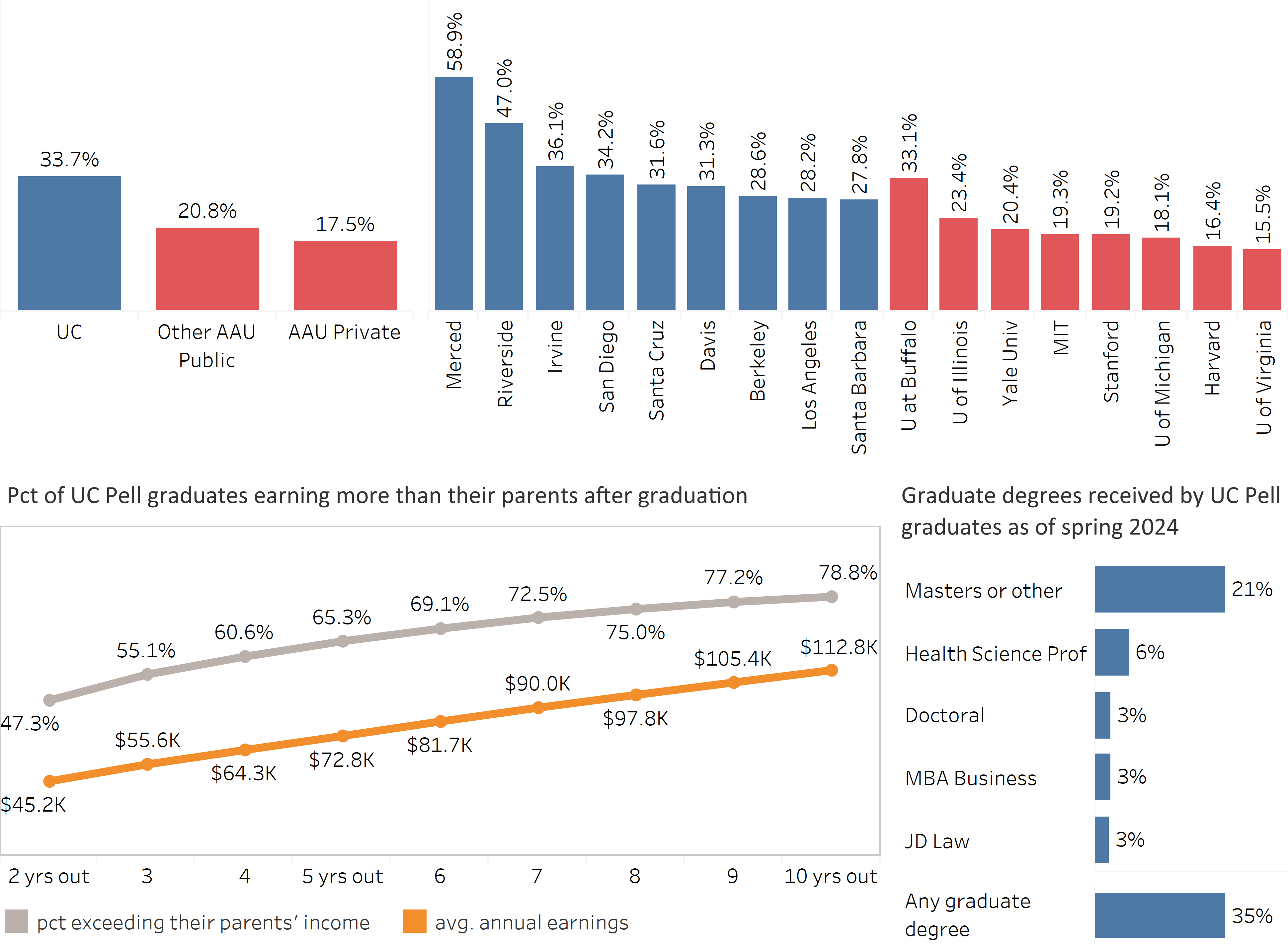
Thirty-four percent of UC undergraduates are Pell Grant recipients, a higher percentage than AAU peers. UC Pell recipients achieve economic mobility, surpassing their parents’ earnings within a few years of graduating from UC.
3.2.1 Undergraduate Pell Grant recipient enrollment and economic mobility, UC and comparison institutions, 2023–24
sources: UC Information Center and IPEDS
UC enrolls a higher proportion of Pell Grant recipients than other AAU comparator institutions. UC Pell graduates more than double their earnings within ten years of graduating and nearly 80 percent earn more than their parents did while they were enrolled at UC. More than one-third of Pell graduates go on to earn a graduate degree at UC or elsewhere.
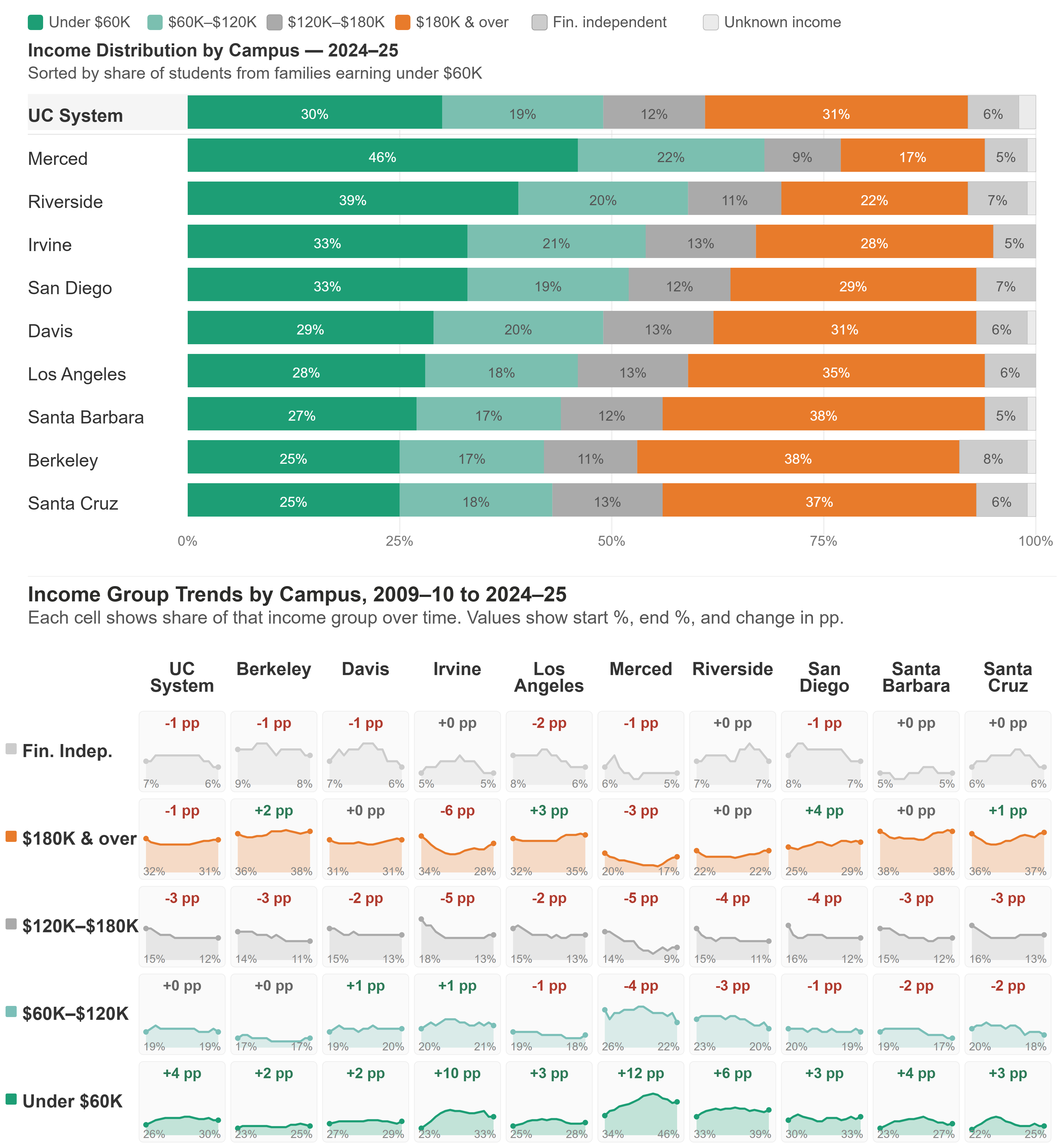
About 30 percent of in-state students come from low-income families, up four percentage points from 15 years earlier.
3.2.2 Undergraduate income distribution, Universitywide, 2024 inflation-adjusted dollars
Source: UC corporate student system
Over the past fifteen years, the share of California resident undergraduates from families earning under $60,000 has grown at nearly every campus, reflecting the strength of Cal Grants, Pell Grants, and UC's Blue and Gold Opportunity Plan in making attendance financially accessible for lower-income students. The share from families earning $180,000 or more has increased primarily at the more selective campuses. The middle-income tiers have remained constant or declined at most campuses, although recent increases to the state Middle Class Scholarship Program may help address these declines. Merced, Riverside, and Irvine continue to serve the highest proportions of low-income students systemwide.
note: All incomes adjusted to 2024 dollars using CA CPI for urban wage earners.
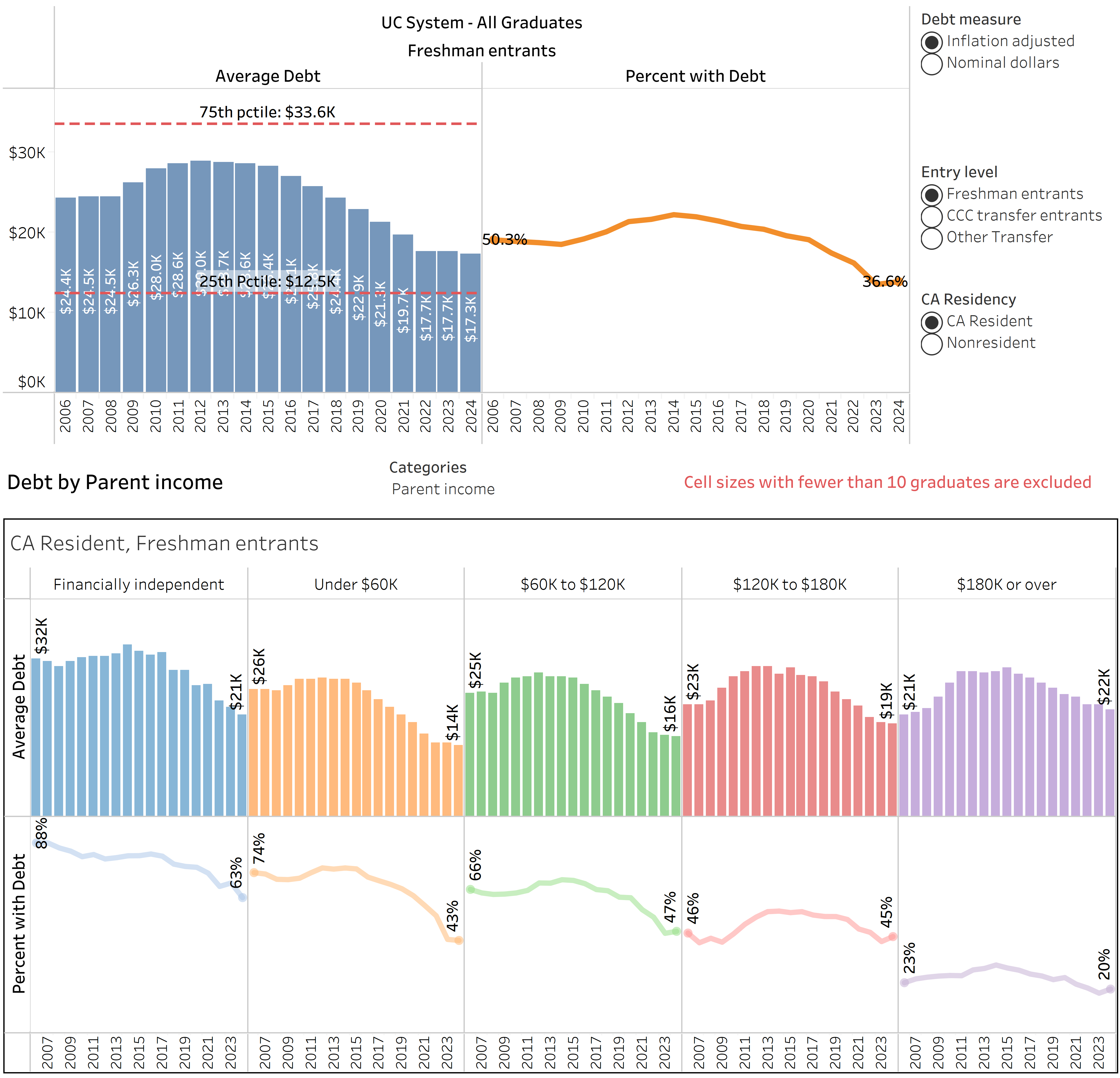
Since 2014, average undergraduate debt has declined by 34 percent while the share of students graduating with debt has also declined by 23 percentage points from 55 percent to 32 percent.
3.3.1 Student loan debt of graduating seniors, inflation-adjusted, Universitywide, 2006–07 to 2024–25 (average debt of those with debt shown above each year)
Undergraduate affordability dashboard | Debt trend
source: UC Information Center
Sixty-eight percent of UC undergraduates graduate with no student loan debt. For those who do borrow, the average student loan debt at graduation in 2024–25 was about $18,800. California resident students are more likely to graduate with student loan debt, about 37 percent compared to 15 percent of out-of-state students. In-state graduates’ average debt, however, was significantly lower than that of the out-of-state students who borrowed ($17,300 vs. $33,400).
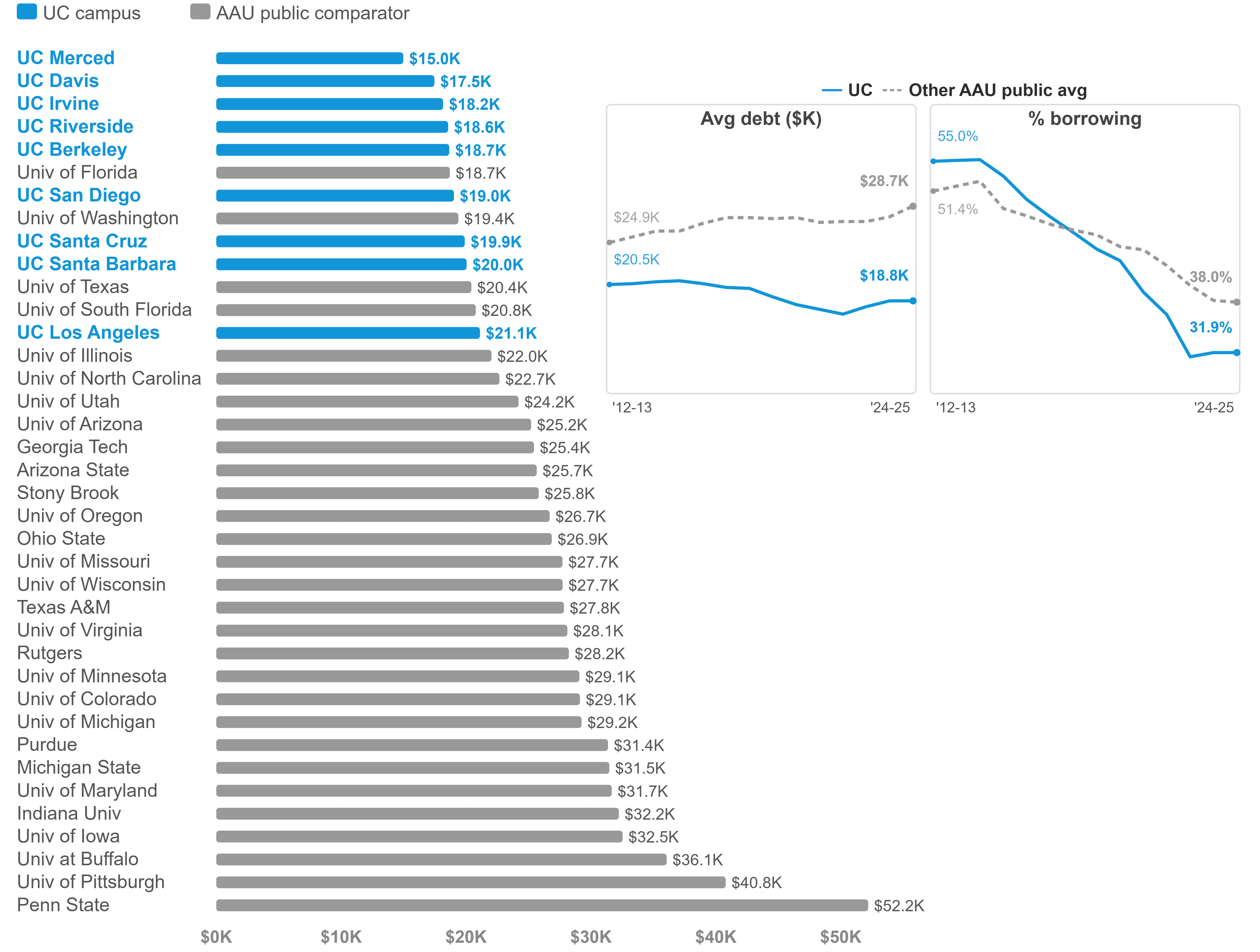
Student loan debt levels at UC campuses are among the lowest within the Association of American Universities (AAU) public institutions.
3.3.2 Undergraduate debt at graduation, UC and public comparison institutions, 2024–25 or most recent available
sources: UC Corporate Student System, Institutional Common Data Sets
UC graduates carry $10,000 less debt than the average for graduates from peer institutions — and the gap has been widening. Between 2012–13 and 2024–25, the gap in average debt between UC and public comparators grew from $4,000 to $10,000. Peer institution average debt rose 16 percent in nominal terms while UC’s declined.
This isn’t primarily about cost. UC tuition is broadly comparable to other flagship public universities. The difference is how much financial support is available to students in California, which has built one of the most comprehensive state financial aid systems in the country — the Cal Grant program covers full tuition for more than 80,000 low- and middle-income UC students as an entitlement, and the Middle Class Scholarship, first enacted in 2012 and significantly expanded in 2022, extends grant aid to families earning up to $217,000. UC’s own institutional aid programs layer on top, ensuring that UC is financially accessible to all California students.
The practical result: UC graduates enter the workforce with more financial flexibility. Lower debt means more freedom to pursue careers in public service, education, the arts, or other fields where starting salaries are more modest. As indicator 3.3.3 shows, UC graduates already demonstrate highly manageable debt-to-earnings ratios — a direct benefit of entering the workforce with less debt than their peers.
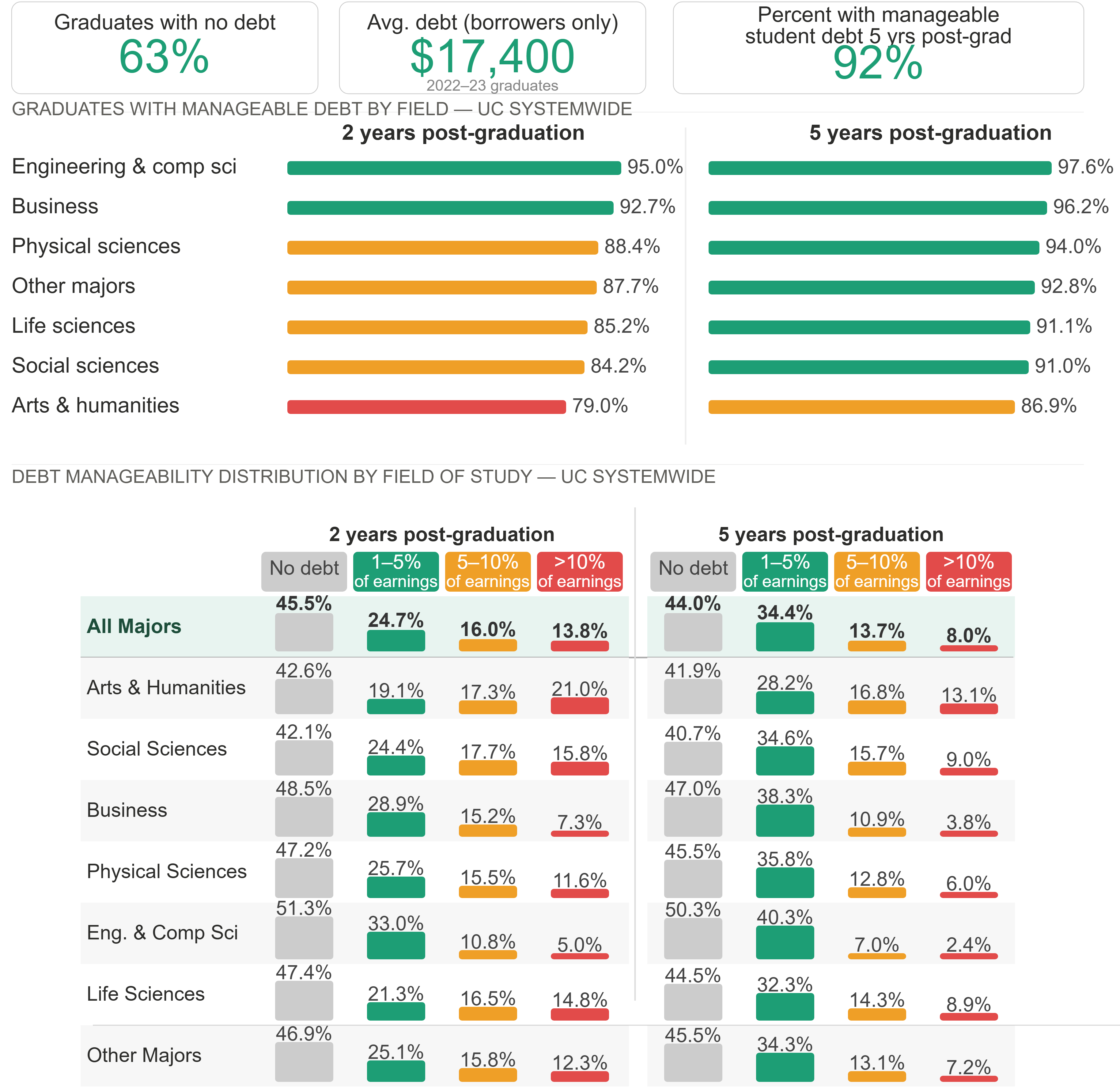
By five years after graduation, over 90 percent of students have manageable debt-to-earnings ratios of less than ten percent.
3.3.3 Percent of UC undergraduate alumni with manageable debt-to-earnings ratios (below ten percent) at two and five years after graduation by degree major, Universitywide and by campus, Undergraduate graduating cohorts 2000–2022 who are working in California
sources: UC corporate student system and CA Employment Development Department quarterly wage record
UC’s Education Finance Model (EFM) considers debt that requires between five percent and nine percent of a student’s postgraduate earnings to be manageable. Most UC undergraduate graduates working in California carry a manageable amount of student debt. Nearly two-thirds (63%) finish with no debt, and among borrowers the average balance is $17,400. Manageability increases with time in the workforce: 86% of borrowers fall within the manageable range two years after graduation, rising across all fields of study by year five. Engineering and computer science graduates have the highest manageability rates at both time points (95.0% and 97.6%) while arts and humanities graduates have the lowest (79.0% and 86.9%), which stems in large part from engineering and computer science graduates typically entering higher-paying roles than arts and humanities graduates. The share of graduates whose debt exceeds 10% of earnings declines from 13.8% at two years to 8.0% at five years across all majors, consistent with earnings growth over time.
For more information
Explore the UC Information Center dashboards that provide downloadable data and context on undergraduate affordability with this subject area-specific url:
universityofcalifornia.edu/about-us/information-center#undergraduate-affordability
Some examples include:
Download data tables for chapter 3 indicators (Excel format)
Chapter Three: Undergraduate Students | Affordability
Key takeaways:
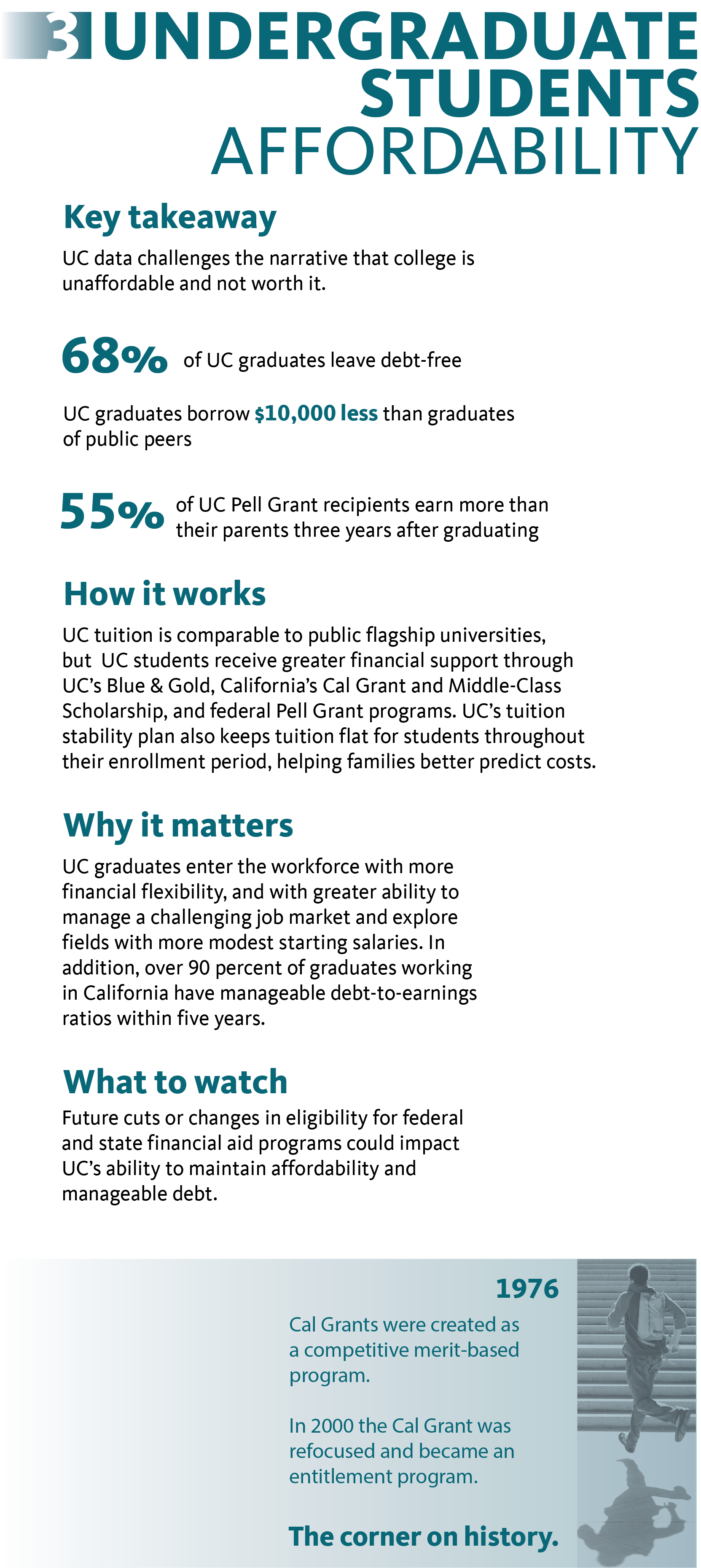
- UC data challenges the narrative that college is unaffordable and not worth it.
- Sixty-eight percent of UC graduates leave debt-free, and UC graduates borrow $10,000 less on average than graduates of public peer institutions.
- Fifty-five percent of UC Pell Grant recipients earn more than their parents three years after graduating.
How it works:
UC tuition is comparable to public flagship universities, but UC students receive greater financial support through UC’s Blue & Gold, California’s Cal Grant and Middle-Class Scholarship, and federal Pell Grant programs. UC’s tuition stability plan also keeps tuition flat for students throughout their enrollment period, helping families better predict costs.
Why it matters:
UC graduates enter the workforce with more financial flexibility, and with greater ability to manage a challenging job market and explore fields with more modest starting salaries. In addition, over ninety percent of graduates working in California have manageable debt-to-earnings ratios within five years.
What to watch:
Future cuts or changes in eligibility for federal and state financial aid programs could impact UC’s ability to maintain affordability and manageable debt.
UC’s corner on history:
In 1976, Cal Grants were created as a competitive merit-based program. In 2000 the Cal Grant was refocused and became an entitlement program.